
Keep the supply moving
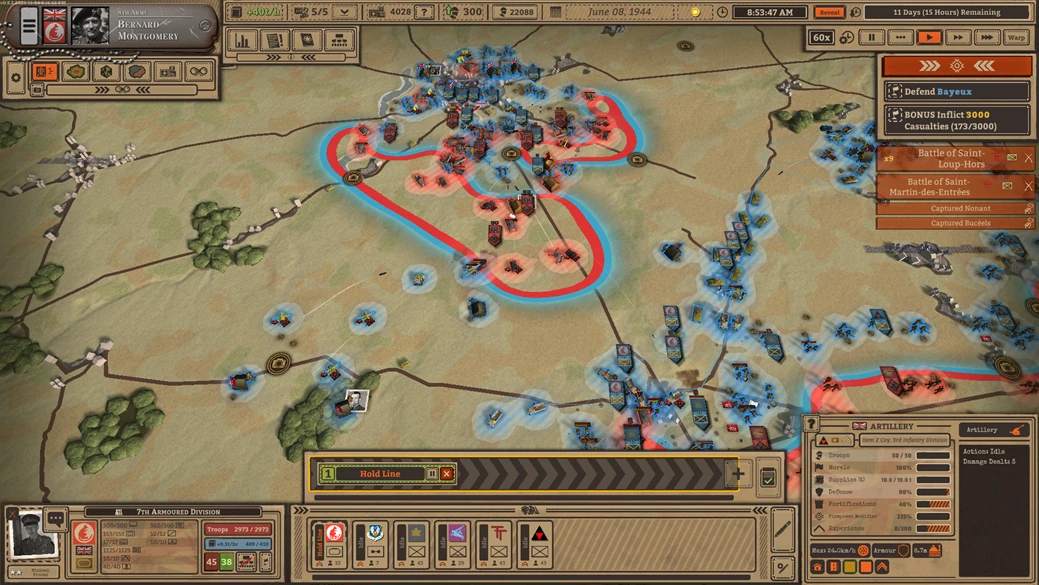
Follow a low-supply company back to its division HQ, then inspect the depot route. Since v1.2.0, transfer speeds up near depots, especially for headquarters.
A depot showing stock and a company showing low supply can both be telling the truth. One is storage; the other is the condition of a unit doing work. Trace the formation's supply relationship before creating another depot or assuming that the display is broken.
Trace the chain in the right order
The developer describes fixed supply hubs, depots that store and distribute supplies, and transfer to the division headquarters. Distance and terrain along the depot-to-HQ route affect delivery. Companies track supply individually, so a division total can hide a depleted part of the formation. Moving and fighting increase demand compared with inactivity.
Start with the affected company, identify its division and locate that division's headquarters. Then inspect the depot and the route between them. The official supply diary is the reference for that chain. A depot near a visible frontline company is not, by itself, a complete diagnosis.
Use the faster transfer near a depot
Since v1.2.0, supply transfers faster near depots, especially to headquarters. Begin with the low-supply company and follow it back to its division HQ. If the depot has stock but the headquarters is a long way forward, find a protected depot position that serves the new HQ location. If the company is fighting while the division replenishes, compare its bar with a quieter company in the same formation before moving the depot again.
After loading a mission save, check which formation placed the depot and follow the route from that depot to the intended headquarters. v1.2.1 fixed saves losing the record of who placed it. A full depot and a depleted company can still coexist if the delivery route or demand is the problem. v1.2.0 supply changes · v1.2.1 save changes
A stocked depot is only the first question
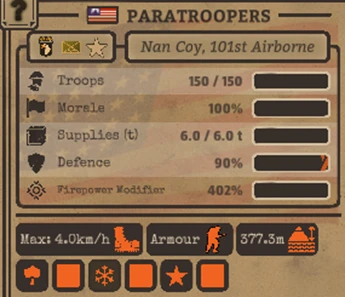
When a depot total rises but a unit's bar does not, separate three observations: the depot has stock, the formation has a delivery relationship and the company is consuming supply. Do not let the first observation stand in for the other two. Ask what the affected formation is doing and whether other companies in the same division show the same pattern.
| Observation | Inspect next | What the check helps distinguish |
|---|---|---|
| One company is depleted | Its task and parent division | A local condition versus a shared formation problem |
| Many companies in one division are depleted | HQ and depot relationship | A shared route or demand problem |
| The depot has stock | Route and receiving formation | Storage versus effective delivery |
| Supply worsens after an advance | New HQ distance and exposed corridor | A changed route versus an unchanged plan |
If several companies share a supply problem, check the HQ route before changing each company’s order.
Plan the next route before extending the attack
Before committing to another objective, compare the intended forward position with the headquarters and depot. Ask what will protect the route and whether the formation's activity is likely to demand more supply. A route that was acceptable during preparation deserves another look during sustained fighting.
Consider a breakthrough that leaves friendly forces near its start and end but little protection between them. The attractive next target should not distract you from the corridor. A useful planning exercise is to assign responsibility for protecting that corridor before extending the spearhead. If no force can perform that job, reconsider the next phase rather than assuming the original supply arrangement will follow automatically.
Choose a depot position for two reasons
A forward depot may help the logistics of a forward force, but its position must also be defensible. Ask who protects it, how a reserve would respond to a threat and whether its location creates another obligation for an already stretched line. The closest possible location is not automatically the most useful one.
If you decide another depot is necessary, check the scenario's allowance and the game’s construction controls. Check when that depot can begin supplying the formation. Give the operation a phase that allows its logistics to become ready rather than treating placement as proof that supply has already recovered.
Capture and encirclement need separate checks
The published system distinguishes denying an enemy hub from taking stored depot supplies. Capturing a hub does not simply turn its production into your own. Captured depot stock can be useful, and stored supplies can delay the effects of an encirclement. Avoid assuming an isolated force is immediately empty or that every captured logistics site supports your army in the same way.
For a planned encirclement, check the ground your force must hold after closing the route. For a captured depot, inspect the new situation rather than building the next phase around a presumed quantity. Both decisions benefit from reading what the game actually displays after the event.
What to record if supply remains unexplained
Record the build, scenario, company and parent division, HQ position, depot position and active order. Describe whether the problem affects one unit or several, and whether it began after a movement or combat phase. A screenshot of the relevant panels can be more useful than a wide map alone.
For the broader planning routine, return to Your first battle; for a depot threatened by a thin line, use the defence guide.